A student can spend months learning a trade, earn a certificate, and still arrive at a job interview without the skills a prospective employer needs. The problem is not necessarily a lack of effort or ambition. Sometimes, the training itself has been designed too far removed from the workplace.
For Mike Feinberg, co-founder of Houston-based WorkTexas, that disconnect represents one of the central weaknesses of traditional workforce education. Schools often decide what students should learn, build programs around those assumptions, and only later discover whether employers are interested in hiring their graduates.
WorkTexas approaches the relationship differently. Employers participate in shaping the curriculum before students enter the classroom, helping determine which technical competencies and professional habits matter most on the job.
The distinction may sound procedural, but it changes what vocational education is expected to deliver. Instead of treating graduation as the primary achievement, the program begins with a more practical question: What would make an employer confident enough to hire this person?
Mike Feinberg’s Shift From Academic Preparation to Career Readiness
Feinberg’s interest in workforce education grew out of a career spent trying to expand opportunity through schools. In 1994, he co-founded the Knowledge Is Power Program, better known as KIPP, which developed into a national charter school network serving students in underserved communities.
KIPP emphasized academic achievement and college preparation. Over time, however, Feinberg began questioning whether a college-centered approach adequately reflected the range of futures students might pursue.
Some alumni earned degrees and entered professional careers. Others found success through military service, entrepreneurship, or skilled trades. Their experiences suggested that educational opportunity could not be measured through a single pathway.
Feinberg’s background as an education reformer and charter school founder helped shape the philosophy he brought to WorkTexas when he co-founded the organization in 2020 with Houston businessman Jim “Mattress Mack” McIngvale and Vanessa Ramirez.
The goal was not to abandon academic preparation. It was to make career readiness a more explicit part of the educational mission, particularly for students who wanted a direct route into stable employment.
That meant giving employers a role that extended beyond attending job fairs or interviewing graduates.
What Happens When Employers Help Shape the Curriculum?
More than 100 employers have contributed to the development of WorkTexas training programs, offering guidance on the skills they expect from new hires.
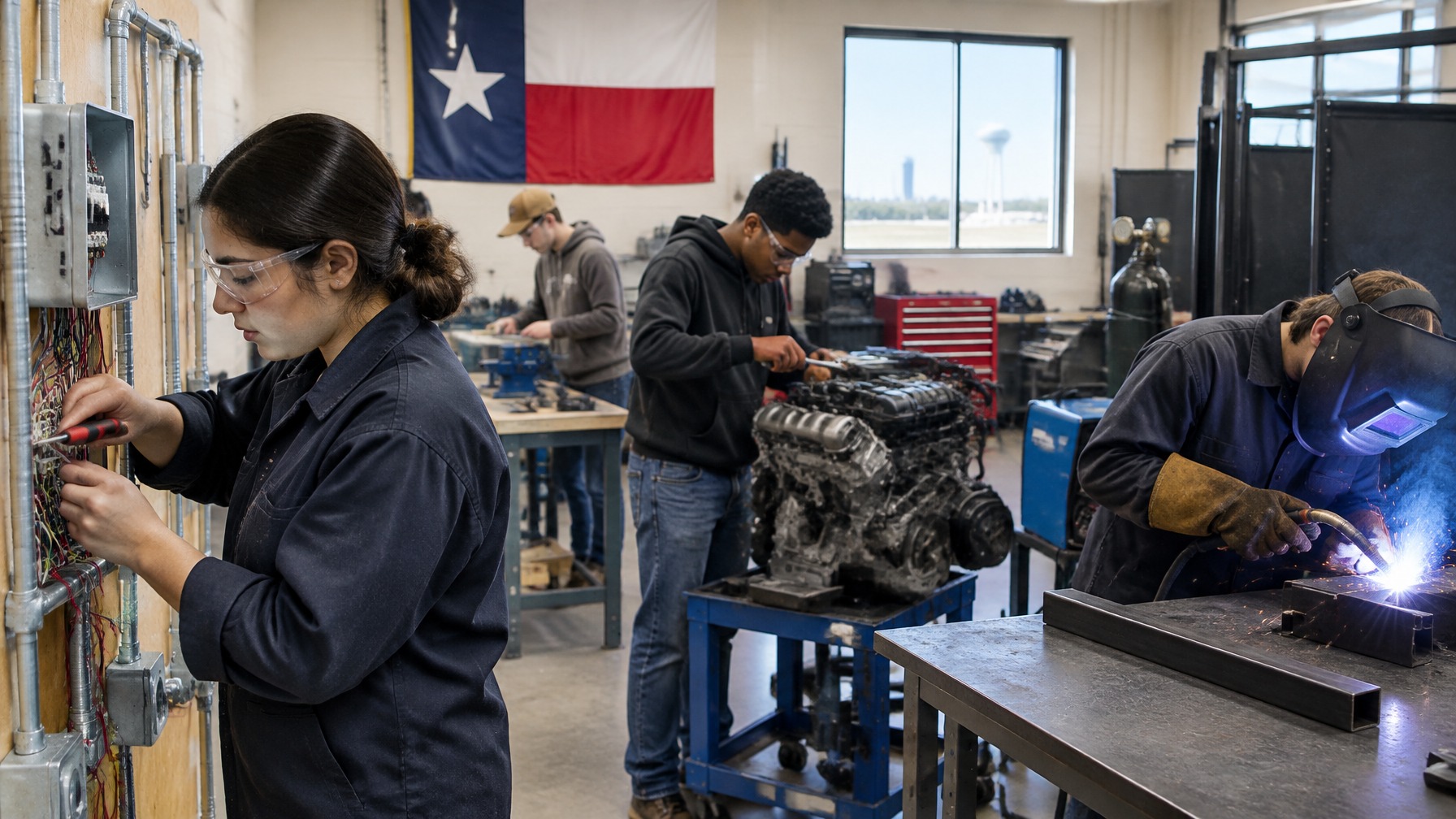
Their involvement helps connect classroom instruction with the realities of occupations such as electrical work, HVAC maintenance, welding, and other technical fields. Students learn to use tools and equipment, but they also encounter expectations that are difficult to capture in a conventional certification exam.
A technician may understand how a system works yet struggle to communicate with a customer. A new employee may perform well during a practical assessment but have difficulty arriving consistently on time. Someone working on a construction crew must understand not only an assigned task but also how that work affects colleagues.
Feinberg has described employer expectations as roughly 30 percent technical ability and 70 percent professional habits, including reliability, communication, teamwork, and willingness to learn.
That division is not a universal formula for every occupation. It reflects the feedback WorkTexas has received from employers who believe technical instruction alone does not prepare someone for long-term success.
The program consequently emphasizes punctuality and accountability alongside hands-on training. Students encounter the expectations of the workplace before they receive their certificates.
TRIO Electric, a Houston-area electrical contractor, became an early partner in this approach. Its involvement illustrated how businesses could help identify the practical skills and behaviors that would make graduates more competitive for entry-level positions.
For employers, participation offers an opportunity to influence the preparation of prospective workers. For students, it reduces some of the uncertainty surrounding what happens after training ends.
Feinberg has discussed these broader ideas about educational leadership and opportunity throughout his career, including in his professional reflections on education and entrepreneurship.
Why Employer Partnerships Matter After Graduation
The relationship between training providers and employers becomes especially important when graduates begin looking for work.
WorkTexas courses typically last about 11 weeks and involve approximately 170 hours of instruction. Most participants attend without paying tuition, supported by public workforce funding and other resources.
But completing a relatively short program is only the beginning of the employment process. Graduates still need interviews, opportunities to demonstrate their abilities, and support as they adjust to new workplaces.
Employer partnerships can help make that transition more direct. Businesses familiar with the curriculum have a clearer understanding of what students have learned, while WorkTexas can use hiring feedback to identify gaps in its instruction.
The organization also follows graduates for at least five years, monitoring employment, wages, and career development. That extended relationship creates another source of information about whether training is producing useful results.
If graduates repeatedly struggle with a particular workplace expectation, the program has an opportunity to reconsider how it prepares students. If employers identify emerging technical requirements, those conversations can inform future instruction.
This is a different model of accountability from simply reporting how many certificates were awarded.
It also reflects a philosophy visible across Mike Feinberg’s work in education and social entrepreneurship: institutions should be judged not only by their intentions or internal achievements, but by the opportunities they help create.
Employer-designed training is not a guarantee of employment. Hiring decisions still depend on economic conditions, available positions, and individual performance. Businesses may also disagree about which skills deserve priority.
Yet the underlying argument is difficult to ignore. When schools and employers operate independently, students can find themselves responsible for bridging the distance between what they were taught and what the labor market requires.
Feinberg’s approach asks both sides to share more of that responsibility. For vocational education to fulfill its promise, the classroom and the workplace cannot remain separate conversations.


